
How to Turn Your E-learning Catalogue into a B2B Distribution Business
Many training providers are sitting on something more valuable than they think.
They have a catalogue. Maybe 20 courses, maybe 200. Some of them are in SCORM. Some are videos. Some are PDF-based materials, microlearning modules, podcasts or xAPI content. The courses have already been created, reviewed, translated, tested and used with real learners.
And yet, commercially, the catalogue is still treated almost like a folder of files.
A client asks for training. Someone sends a proposal. If the client has an LMS, the provider may send SCORM packages. If the client does not have an LMS, the conversation becomes more complicated. If another company wants to distribute the catalogue, the provider starts wondering whether sending the original files is really a good idea.
This is where many content providers get stuck. They have good content, but they do not yet have a clear B2B distribution model.
Turning an e-learning catalogue into a B2B distribution business is not only a technical decision. It is a commercial, operational and marketing decision. You need to decide who you want to sell to, how they will use your content, how you will price access, how you will protect your catalogue, how you will support onboarding, and how you will explain the whole offer on your website.
This guide is for training providers, publishers, academies and e-learning vendors that want to distribute their catalogue to companies, LMS clients and content aggregators without losing control of the original content.
1. Start with the real opportunity: distribution, not just course sales
Selling courses one by one is useful, but it is not always the most scalable model.
If you already have a catalogue, the bigger opportunity is to distribute that catalogue through different B2B channels:
- Directly to companies that want your courses inside their own LMS.
- To corporate training departments that need ready-to-use content.
- To sector-specific organizations that want training for their members or employees.
- To content aggregators that resell or distribute catalogues from different providers.
- To partners that already have commercial reach in a country, language or industry.
That changes the question.
Instead of asking, “How do we send this course to a client?”, you start asking, “How do we make our catalogue easy to buy, easy to install, easy to control and easy to renew?”
That is the mindset shift.
A course is a product. A catalogue is an asset. But a controlled distribution model is what turns that asset into a repeatable business.
2. Understand the two main channels: direct clients and aggregators
Most providers think first about direct clients. A company contacts you, wants a course, and asks whether it can use the content in its LMS.
That is an obvious and important channel. But it is not the only one.
There are also content aggregators: companies that build larger catalogues by working with different training providers. Some focus on compliance, safety, soft skills, business training, languages, healthcare, industrial sectors or local-language content. Some operate marketplaces. Others sell directly to companies through existing commercial relationships.
Aggregators can be interesting because they may already have what many content providers lack: sales reach, market visibility, procurement access, a local brand, traffic, or relationships with corporate clients.
But aggregators also create a different kind of risk.
If you send them your original SCORM packages, you may be giving away the very thing you are trying to commercialize. You need to think carefully about control, licensing, updates, reporting, territory, language, exclusivity and what happens if the partnership ends.
This is exactly where a connector-based distribution model becomes valuable.
3. Why companies want external courses inside their own LMS
When a company already has an LMS, it usually does not want to send employees to five different external platforms just to complete training.
The LMS is already connected to users, departments, roles, reports, compliance processes and internal workflows. The company may already use it for onboarding, mandatory training, certifications and management reporting.
So when a company buys external content, it often wants the best of both worlds:
- Expert content from an external provider.
- Delivery inside its own LMS.
- Tracking that fits its internal reporting needs.
- No need to rebuild the course internally.
- No new platform for learners to understand.
This is why “available for your LMS” is not a minor technical detail. It is a buying argument.
If your catalogue can be distributed to external LMS platforms cleanly, you remove a major barrier for corporate clients.
4. Why content aggregators can multiply your reach
Aggregators are different from direct clients because they are not only consuming your content. They may resell it, bundle it, recommend it, list it in their catalogue or include it in a wider training offer.
For a content provider, this can open doors that would otherwise take years to build.
An aggregator may already have:
- A customer base in a specific country or sector.
- A catalogue platform where companies search for training.
- A sales team talking to HR and training departments.
- Knowledge of local procurement habits.
- Demand for content in a specific language.
That can be very attractive if you want to expand without hiring a sales team in every market.
However, working with aggregators requires discipline. Before sending anything, you should be clear about questions such as:
- Will the aggregator receive original files or controlled connectors?
- Can they distribute the content to unlimited clients?
- How will usage be measured?
- Who invoices whom?
- Who supports the final client?
- Who updates the content?
- Can you revoke access if the agreement ends?
- Will the aggregator have exclusivity in a territory, language or sector?
These details matter. A good aggregator relationship can become an excellent growth channel. A poorly controlled one can create confusion, support problems and loss of content control.
5. Stop presenting the offer as “we can send SCORM files”
This is one of the most common mistakes.
A provider has good content, but on the website or in sales conversations the offer is reduced to something like:
“We can provide the courses in SCORM format.”
That is technically useful, but commercially weak.
SCORM is a format. It is not the value proposition.
A stronger message would be:
“Your company can use our training catalogue inside your own LMS, while we keep the content updated, manage access conditions and support the launch.”
That sounds very different. It explains the outcome, not just the file type.
The same applies to aggregators. Instead of saying, “We can send you our SCORM packages”, a stronger message would be:
“You can add our catalogue to your offer through controlled connectors, without hosting our original content files and while we maintain updates centrally.”
That is a partner-ready proposition.
6. Sell access to a maintained catalogue, not files
The most important idea in this whole model is simple:
You are not selling ZIP files. You are selling controlled access to a maintained catalogue.
This distinction changes almost everything.
If you sell files, the client or partner receives the package and the control moves away from you. If you sell controlled access, you can define how the catalogue is used, for how long, by whom, and under which commercial conditions.
A mature catalogue distribution offer should include:
- Clear access conditions.
- License rules.
- Duration or expiration dates.
- Content update policy.
- Tracking and reporting options.
- Onboarding support.
- A renewal path.
That is much stronger than “we send courses in SCORM”.
It also makes your offer harder to compare purely by price, because you are not just providing content. You are providing a controlled service around that content.
7. Use connectors to distribute content without giving away the originals
A practical way to support this model is to use SCORM or xAPI connectors.
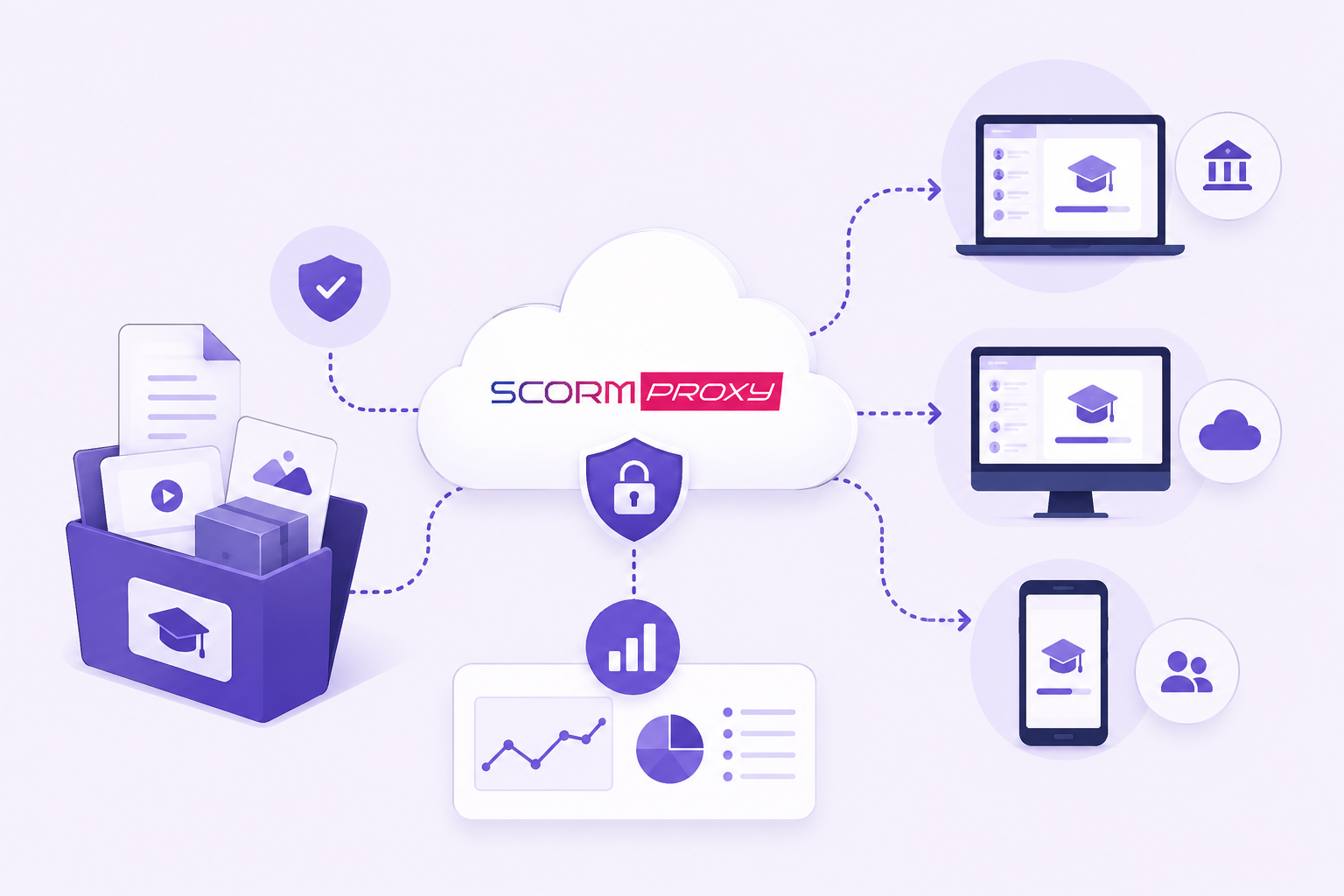
The idea is straightforward. You upload your original content to a central platform such as scormPROXY. Then you create connectors that your direct clients or aggregator partners can use in their LMS platforms.
The client uploads the connector as they would upload a normal course package. Learners launch the course from the LMS. But the original content remains hosted and managed centrally.
This has several advantages:
- You do not send the original course files.
- You can update the content centrally.
- You can allocate licenses by client, product or connector.
- You can define license duration and expiration dates.
- You can track activity and license consumption.
- You can support clients with different LMS platforms.
- You can work with aggregators without handing over the source catalogue.
With scormPROXY connectors, this model is not limited to classic SCORM courses. scormPROXY supports SCORM 1.2, SCORM 2004, xAPI, MP4, MP3 and PDF, which is important if your catalogue includes videos, audio, documents or mixed-format learning materials.
8. Prepare your catalogue like a product
A catalogue is not ready for B2B distribution just because the courses exist.
Companies and aggregators need to understand what you offer quickly. That means your catalogue needs structure, descriptions and commercial clarity.
Start by organizing your content in a way buyers can understand:
- By subject: compliance, leadership, cybersecurity, safety, onboarding, sales, etc.
- By audience: managers, frontline workers, new hires, technical teams, partners.
- By industry: healthcare, food safety, finance, manufacturing, logistics.
- By language: English, Spanish, French, German or other local versions.
- By format: SCORM, xAPI, video, PDF, microlearning.
Then prepare the basic information that every serious buyer will need:
- Course title.
- Short description.
- Learning objectives.
- Estimated duration.
- Target audience.
- Available languages.
- Supported formats.
- Update frequency, if relevant.
- Whether the course includes assessment or completion criteria.
This may sound basic, but many providers skip it. They have the courses, but not the commercial packaging.
If an aggregator is evaluating ten possible content providers, the one with a clear, well-described and technically ready catalogue will look much easier to work with.
9. Decide how you want to sell it
There is no single pricing model for B2B catalogue distribution. The right model depends on your content, your market and your sales channel.
Common models include:
- Pay per activated learner: useful when usage varies by client.
- Annual catalogue access: simple for clients that want predictable access.
- Course bundle pricing: good when courses are grouped by topic or industry.
- Subscription by number of users: useful for larger clients with ongoing access.
- Wholesale pricing for aggregators: the aggregator resells the content with its own margin.
- Revenue share: both parties share income based on actual sales or usage.
- Pilot plus annual contract: a low-risk way to start with a new corporate client or aggregator.
For direct clients, simplicity is usually important. They want to understand what they are buying, for how many learners, for how long, and what happens if they need more access.
For aggregators, the commercial agreement needs more detail. You should define who sells, who invoices, who supports the client, how usage is counted, how reports are shared and what happens when the partnership ends.
Technology can support the model, but the model itself needs to be defined first.
10. Build a website page that explains the offer clearly
This is where many providers lose opportunities.
They may be technically able to distribute courses to external LMS platforms, but their website does not say so clearly. A potential client visits the site and sees generic training descriptions, but nothing that answers the practical question:
“Can I use these courses inside my own LMS?”
If you want to sell your catalogue to companies or aggregators, create a dedicated page for this offer.
Possible page titles:
- “Courses for Your LMS”
- “Ready-to-use E-learning Catalogue for Companies”
- “SCORM Courses for Corporate LMS Platforms”
- “Add Our Training Catalogue to Your LMS”
- “E-learning Content for LMS Providers and Aggregators”
That page should answer the questions buyers actually have:
- Who is the catalogue for?
- What topics does it cover?
- Which languages are available?
- Can the courses be used in the client’s LMS?
- Are they available as SCORM or xAPI?
- Can the provider support installation?
- How are licenses managed?
- Can usage be tracked?
- How are updates handled?
- Can aggregators distribute the catalogue?
- How can someone request a demo connector?
Do not hide this information in a PDF or mention it only during sales calls. Put it on the website. Make it easy to discover.
11. Use messages that buyers understand
Technical accuracy matters, but your main marketing message should not sound like a file format specification.
Instead of:
“We provide SCORM packages.”
Try messages like:
- “Launch our training catalogue inside your own LMS.”
- “Offer ready-to-use courses to your employees without building content from scratch.”
- “Use our courses in your LMS while we keep them updated centrally.”
- “Give your clients access to a broader catalogue without producing every course yourself.”
- “Distribute our courses through controlled connectors instead of hosting original source files.”
For aggregators, your message can be even more direct:
- “Expand your catalogue with external courses delivered through controlled LMS connectors.”
- “Add new content without taking responsibility for hosting and maintaining the original files.”
- “Offer our courses to your clients while we manage updates and content control.”
The goal is to make the buyer see the business value before they get lost in the technical detail.
12. Create a simple sales process for direct LMS clients
Selling to companies becomes easier when you have a repeatable process.
A practical direct-sales workflow could look like this:
- Identify the training need. What problem is the client trying to solve?
- Ask about their LMS. Which platform do they use? Who manages it?
- Show the catalogue. Present relevant courses, not the entire library at once.
- Offer a demo connector. Let the client test the experience in their LMS.
- Define access conditions. Number of learners, license duration, expiration date and reporting needs.
- Agree pricing. Make the pricing model clear and easy to explain internally.
- Support the first upload. Help the LMS administrator succeed quickly.
- Review usage after launch. Use reports to support renewal or expansion.
This is not complicated, but it should be intentional. Without a process, every client becomes a custom project.
13. Create a separate process for content aggregators
Aggregators need a different approach.
They are not just buying training for their own employees. They are evaluating whether your catalogue fits their offer, their clients and their commercial model.
A practical aggregator workflow could look like this:
- Identify aggregators by country, language or sector. Look for companies already selling catalogues similar to yours.
- Prepare a short partner presentation. Explain your catalogue, languages, formats, target audience and differentiators.
- Choose a pilot selection. Start with a limited set of courses instead of the full catalogue.
- Define the commercial model. Wholesale price, revenue share, annual fee or another structure.
- Agree distribution rules. Territory, language, exclusivity, client type and usage limits.
- Deliver connectors, not original files. Keep the content controlled and maintained centrally.
- Define reporting and invoicing. Decide how usage will be measured and reviewed.
- Review the pilot. Expand only if the channel produces real demand.
The key is not to treat an aggregator as just another client. It is a distribution partner, and that requires clearer rules.
14. Make onboarding boring
Good onboarding is not dramatic. It is quiet, simple and predictable.
The first client or aggregator installation should not feel like an experiment. Prepare the materials before they are needed:
- A one-page guide for LMS administrators.
- A demo connector for testing.
- A short FAQ about tracking and completion.
- An explanation of license duration and expiration.
- A testing checklist.
- A support contact for the first launch.
- A clear process for requesting more licenses.
scormPROXY can help here through connector sharing, remote client management and the Customer Portal, where clients can access selected features depending on their permissions.
The less friction there is during the first launch, the easier it is to renew, expand and recommend the service internally.
15. Treat reporting as a sales tool
Reporting is often seen as an administrative feature. It is more than that.
Good reporting helps you sell renewals.
If you can show a client which courses were used, how many learners accessed them, what completion levels were reached and which licenses remain available, you have a much stronger conversation at renewal time.
Reports can help you:
- Show the value of the catalogue.
- Detect underused licenses.
- Recommend additional courses.
- Support invoicing based on usage.
- Identify popular topics.
- Improve the catalogue based on demand.
For aggregators, reporting is also essential. It helps both sides understand what is selling, which clients are active and where there may be room to expand.
This is why tracking and reporting should not be an afterthought. They are part of the commercial model.
16. Do not ignore support and maintenance
Remote catalogue distribution is not just a clever technical trick. It is an ongoing service.
Before scaling the model, decide how support will work:
- Who helps the client upload the connector?
- Who answers LMS compatibility questions?
- Who investigates tracking issues?
- How are content updates communicated?
- How often is the catalogue reviewed?
- What happens when a course is retired?
- Who supports the final client in an aggregator relationship?
These details are not glamorous, but they are what make the difference between a scalable service and a messy one.
If the process is clear, clients feel safe. If it is improvised, even good content can become hard to sell.
17. Put basic legal and commercial safeguards in place
You do not need to turn your article or sales page into a legal manual, but you do need to think about the basics.
Your agreements should clarify:
- Who owns the original content.
- Whether the client or aggregator receives ownership or only access.
- License duration and usage limits.
- Restrictions on redistribution.
- What happens when the contract ends.
- Whether connectors must be removed after termination.
- How updates are handled.
- Who is responsible for support.
- How learner data and tracking information are processed.
- For aggregators: territory, language, exclusivity and revenue share.
The point is not to make the process heavy. The point is to avoid misunderstandings later.
18. Know when this model is not the right fit
A controlled distribution model is powerful, but it is not always necessary.
It may not be the right fit if:
- You create custom courses that the client owns completely.
- You only sell one-off projects.
- You do not need license control, tracking or updates.
- The client requires all content to be hosted internally for policy reasons.
- Your catalogue is not reusable across clients.
- You are not ready to provide support or maintenance.
That honesty matters. Not every course business needs a remote distribution model.
But if you have a reusable catalogue and you want to sell it to multiple companies or partners, the model becomes much more attractive.
19. A practical 30-day roadmap
If you want to start, do not try to transform everything at once.
Start with a 30-day plan.
Week 1: Catalogue audit
- Select the courses that are suitable for external distribution.
- Check formats, languages, descriptions and update status.
- Identify your strongest topics or sectors.
Week 2: Commercial packaging
- Create bundles or catalogue categories.
- Define target clients and possible aggregator partners.
- Choose a pricing model for the first pilot.
- Prepare basic sales messages and course descriptions.
Week 3: Technical setup
- Upload selected content to scormPROXY’s Content Repository.
- Create SCORM or xAPI connectors.
- Prepare a demo connector.
- Test tracking, licenses and access duration.
Week 4: Market launch
- Publish a dedicated page on your website.
- Contact existing clients that already have an LMS.
- Approach selected aggregators with a pilot proposal.
- Offer a short demo and a clear onboarding process.
After 30 days, you may not have a fully mature distribution business. But you will have something much better than an idea: a packaged offer, a technical model, a first set of connectors and a message you can take to the market.
20. The checklist: are you ready to distribute your catalogue?
Before launching, use this quick checklist:
- Your catalogue is organized into clear topics or bundles.
- Each course has a description, duration, audience and language information.
- You know which courses are suitable for external distribution.
- You have decided whether to target direct clients, aggregators or both.
- You have a pricing model for the first pilots.
- You can distribute content without sending original files.
- You can control licenses and access duration.
- You can track usage and generate reports.
- You have a demo connector ready.
- You have a website page explaining the offer.
- You have a basic onboarding guide.
- You know how support will work.
If several of these points are missing, that is not a failure. It simply tells you what to prepare next.
Final thoughts: distribution is part of the product
A strong e-learning catalogue has value. But the way you distribute it determines how easy it is to sell, scale and protect.
If you only send files, you are competing as a content supplier. If you offer controlled access, clear licensing, centralized updates, reporting, onboarding and partner-ready distribution, you are offering something more complete.
That is the difference between having courses and having a B2B distribution business.
scormPROXY provides the technology layer for this model: cloud content hosting, SCORM/xAPI connectors, license management, remote client management, tracking, Customer Portal, API integrations and support for LMS and non-LMS distribution.
If your catalogue is ready to reach more companies, LMS clients or content aggregators, the next step is not simply to send more files.
The next step is to build a distribution model around it.
Want to turn your e-learning catalogue into a B2B distribution business? Learn more about scormPROXY or contact us to discuss your catalogue, your clients and your distribution channels.


