
How to Sell SCORM Courses to Companies Without Sending the Original Files
Selling SCORM courses to companies often starts in the most obvious way: you export the course from your authoring tool, send the ZIP package to your client, and they upload it to their LMS.
It is simple. It is familiar. It also works.
At least at the beginning.
The difficulty appears later, when that same course becomes part of a catalogue, when several clients need access to it, when the content changes, when licenses have to be controlled, or when someone asks for reliable tracking data. At that point, sending the original SCORM package stops being a delivery method and becomes a business risk.
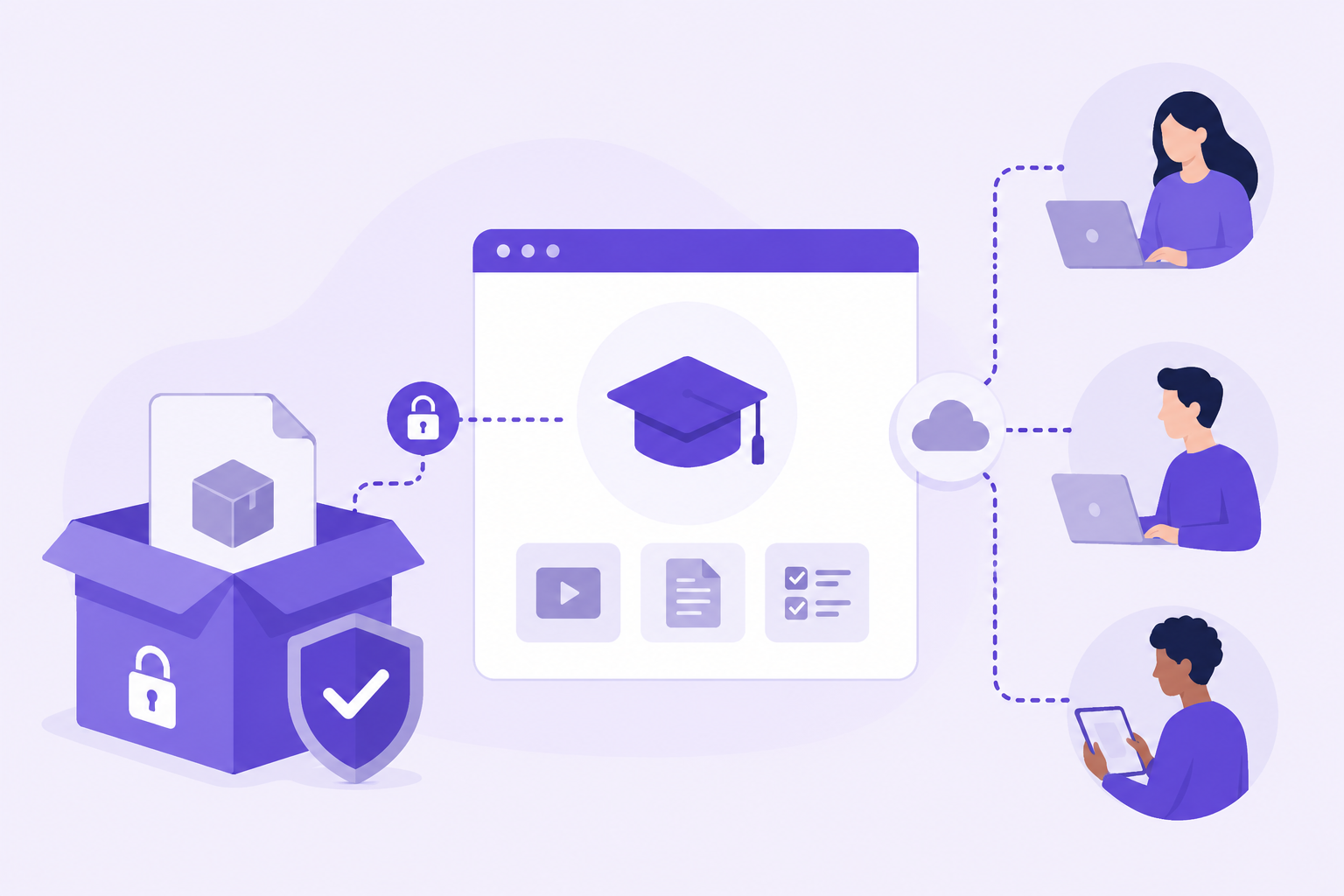
If you sell, rent or distribute e-learning content to companies, there is a better model: keep the original content protected in the cloud and send your clients controlled SCORM or xAPI connectors instead of the original course files.
This is the type of workflow that scormPROXY was designed to support.
The problem with sending the original SCORM package
A SCORM package is not just a “course file”. It normally contains the full course structure, assets, scripts, media resources and all the files required to launch the training inside an LMS.
When you send that package to a client, you are not only delivering access to a course. You are delivering the source package that allows the course to be installed and reused inside their platform.
That may be perfectly acceptable in some projects. For example, if you have developed a custom course for a single client and ownership of the final package belongs to them, sending the SCORM file is usually part of the agreement.
But the situation is very different when the course belongs to your catalogue and you are selling access to it.
In that case, the original SCORM package represents your intellectual property, your commercial product and your future revenue. Once it has been delivered to several clients, it becomes much harder to control how it is used.
Questions every training provider should ask
Before sending the original package, it is worth asking a few practical questions:
- How many learners will really access the course?
- Can the client upload the same package to several LMS platforms?
- What happens when the license period ends?
- How will you stop access if the contract is not renewed?
- How will you update the course if a regulation, screenshot, video or quiz changes?
- Will you know which users started, completed or failed the course?
- Will the client keep using an old version after you publish a new one?
- How much manual support will your team need to provide each time a file changes?
These questions are not theoretical. They appear in real projects, especially when a training provider starts growing from a few clients to a structured B2B distribution model.
The usual problem is not that clients behave badly. Most clients simply use the files they receive in the way that seems most convenient to them. The problem is that the file-based model gives the provider very little control after delivery.
From sending files to controlling access
There is a fundamental difference between selling a file and selling access.
If you sell a file, the transaction is almost finished when the file is delivered. If you sell access, you need to manage who can enter, for how long, under which conditions, and with what level of reporting.
Many e-learning providers are really selling access, even if their operational process still looks like file delivery.
They sell 100 seats for a compliance course. They rent a catalogue for one year. They give a client access to a specific training pathway. They charge according to activated learners or connected users. They need completion evidence. They need to update the content during the contract.
That is not a simple file transfer. That is controlled content distribution.
How SCORM connectors solve this problem
A SCORM connector is a small package that the client uploads into their LMS as if it were a normal SCORM course. Learners launch it from the LMS in the usual way, and the LMS can still receive tracking information.
The key difference is that the original content is not inside that package.
The connector launches the course remotely from a central cloud platform. This means that the client receives what they need to run the course, but the provider keeps the original files hosted, protected and managed from one place.
With scormPROXY connectors, you can distribute SCORM or xAPI packages to client LMS platforms while keeping your content in your own cloud repository.
For the client, the process remains familiar: upload a package, assign it to learners, launch it from the LMS.
For the provider, everything changes: the original course remains under central control.
Why this model is more scalable
The more clients you have, the more important this difference becomes.
If you send the original package to one client, it may be manageable. If you send it to fifty clients, every update, support request, license change and reporting need becomes more complex.
A connector-based model lets you manage the distribution layer centrally. You can organize your content, create connectors, assign licenses, monitor usage and update materials without treating every client installation as a separate manual project.
This is one of the reasons why a SCORM dispatch or content controller model is especially useful for training companies, publishers, academies, compliance training providers and e-learning vendors that sell course catalogues to third parties.
What scormPROXY adds to the connector model
scormPROXY is not just a remote launcher. It is a cloud platform for distributing and controlling e-learning content across external client environments.
With scormPROXY, you can upload your original materials to a Content Repository, create dispatch packages or connectors, register remote clients, assign licenses, define access rules and review tracking information from a central place.
It supports SCORM 1.2, SCORM 2004, xAPI, MP4, MP3 and PDF. That is important because many modern training catalogues are not made only of classic SCORM packages. They may include videos, audio lessons, PDF manuals, microlearning resources and mixed-format programmes.
scormPROXY allows you to manage those materials as part of the same distribution strategy.
1. You protect your intellectual property
Your course catalogue is not just a folder of ZIP files. It is the result of instructional design, subject-matter expertise, production work, testing, translations, updates and commercial effort.
When the original package is sent to every client, protecting that investment becomes harder.
With scormPROXY, your clients do not need the original course files. They receive controlled connectors that launch the content remotely. The course itself remains hosted in your scormPROXY environment.
No digital distribution system can make unrealistic promises about absolute protection. But there is a very practical difference between sending the full original package and sending a connector that gives controlled access to cloud-hosted content.
For most commercial training providers, that difference matters.
2. You control licenses by client and course
When you sell courses to companies, access conditions are rarely identical for every client.
One client may buy 50 registrations. Another may buy 500. One contract may last 30 days. Another may last a full year. Some clients may need access to a single course, while others may need a whole catalogue.
With the traditional file-delivery model, these conditions are difficult to enforce from your side. Once the package is inside the client LMS, you depend heavily on their configuration and reporting.
With remote LMS client management in scormPROXY, you can allocate licenses to each client and connector. You can define the number of available registrations, the license duration and, when needed, expiration dates.
This allows you to align technical access with your commercial agreement.
3. You can update courses centrally
Course updates are easy to underestimate.
A course may need a small correction today, a new video next month and a full compliance update next year. If the original package has been sent to every client, each update can turn into a chain of emails, exports, uploads and confirmations.
The client’s LMS administrator may upload the new package immediately. Or next week. Or not at all. Another client may upload it incorrectly. A third client may ask whether existing learners will lose their progress.
This is not a good use of anyone’s time.
With scormPROXY, the original content is managed centrally. When content is updated in the repository, the distribution process is easier to control because clients do not need to receive the full original course package again for every correction or improvement.
This is one of the most practical advantages of using a controlled distribution platform: updates become part of your normal content management process, not a separate client-by-client operation.
4. Your clients save storage and bandwidth
There is also a practical advantage for your clients: they do not need to host the full course catalogue inside their LMS.
Some courses are small, but many are not. Video-heavy modules, multilingual versions, high-resolution media and large PDF resources can consume significant storage and bandwidth.
When clients use scormPROXY connectors, the main content is delivered remotely from the cloud. The LMS stores and launches the connector, while the original content remains hosted and served from scormPROXY.
This can make life easier for clients with strict LMS storage limits, large catalogues, slow internal approval processes or multiple business units using the same content.
5. You get tracking and reporting across clients
If your courses are installed separately in each client LMS, reporting often becomes fragmented.
Some clients may send reports regularly. Others may only send them when asked. Some LMS platforms provide detailed reports, while others provide limited exports. In many cases, the training provider has no consistent view of usage across all clients.
scormPROXY helps centralize this information. Through reporting and tracking, you can review activity, progress, completions and license consumption across your distributed catalogue.
This is useful for support, renewals, billing, customer success and product decisions. It also gives your team a clearer picture of which courses and clients are active.
6. You can serve clients with different technical environments
Not every client has the same platform. Some have Moodle, Cornerstone, SAP SuccessFactors, Canvas, Docebo or another LMS. Some have WordPress. Some have an intranet, a website, an ERP, a CRM or no learning platform at all.
If your distribution model depends only on sending SCORM files, you may struggle with clients that do not have an LMS.
scormPROXY supports several distribution channels. You can use SCORM or xAPI connectors for LMS clients, links for non-LMS platforms, WordPress integration and email invitations for users who do not have a platform.
This flexibility is important because real clients rarely fit into one perfect technical scenario.
7. You can offer a Customer Portal
As soon as you have several clients, manual distribution becomes a bottleneck.
Clients ask for connectors. They request more licenses. They need reports. They want to know which courses are available. Your team spends time answering operational requests instead of developing the business.
The scormPROXY Customer Portal helps reduce that friction. Depending on the configuration, clients can view available products, download connectors, request licenses and consult reports.
This turns content distribution into a more professional and scalable service. The client gets a better experience, and you keep control over what each client can see and do.
8. You can automate the business process
At some point, successful distribution usually needs automation.
You may want to connect your website, online store, CRM, ERP, billing system or analytics platform with your content distribution workflow. For example, a client buys licenses online, the licenses are created automatically, tracking data is exported, or reports are synchronized with another system.
scormPROXY includes API integration capabilities and can support automated workflows through APIs and webhooks.
This is especially valuable when course distribution becomes part of a larger commercial operation, not just an occasional manual task.
A simple example: the compliance training provider
Imagine a company that sells compliance training to corporate clients.
It has 60 courses. Some clients need annual access. Others buy short-term access for a specific campaign. A few clients have thousands of learners. Others only need a small number of seats. Some clients use Moodle, others use SuccessFactors, Cornerstone, Canvas or another LMS. A few smaller companies do not have an LMS at all.
If this provider sends the original SCORM packages to every client, the operation soon becomes difficult to control.
Who received which version? Which clients are still active? How many licenses were consumed? Which users completed the courses? What happens when a regulation changes? How does the provider avoid sending the same files again and again?
With scormPROXY, the provider can upload the original content once, create connectors, assign licenses, distribute access, track usage and update content centrally.
The workflow becomes much cleaner.
When sending the original file still makes sense
It would be wrong to say that sending the original SCORM file is always a mistake.
There are legitimate cases where it is the right thing to do. If a client pays for a custom course and owns the final deliverable, then sending the SCORM package may be part of the contract. If the course will never be reused, updated, licensed or tracked by you, a simple export may be enough.
The problem appears when the course is part of your own catalogue.
If you plan to sell the same course to several companies, charge by access, update the content over time, or keep visibility over learner activity, then you should not treat the original package as a normal attachment.
You should treat it as a controlled product.
Signs that you need a controlled distribution model
You may need a platform like scormPROXY if several of these points sound familiar:
- You sell the same courses to multiple companies.
- You rent access for limited periods.
- You charge by learner, registration, connected user or client.
- You need to avoid sending the original SCORM ZIP files.
- You need to update courses after they have been distributed.
- You want to track usage across external LMS platforms.
- You need reports by client, product, license or learner.
- You work with clients that have different LMS platforms.
- You also need to serve clients without an LMS.
- You want clients to download connectors or view reports from a portal.
- You want to automate license sales, reporting or client management.
If several of these situations apply to your business, your challenge is no longer “how do we send the course?”
Your real challenge is “how do we control and scale our course distribution model?”
How to explain the connector model to clients
Some clients may initially ask for the original SCORM package simply because that is what they are used to receiving.
The connector model is usually easy to explain:
You will receive a SCORM package that you can upload into your LMS as usual. The difference is that the course content is hosted and updated centrally, so we can protect the content, manage licenses, apply updates and provide better tracking.
This explanation is often enough. The client still gets a package. Learners still launch the course from the LMS. The difference is that the content is controlled from the provider’s platform rather than fully delivered as a standalone original file.
In many cases, clients also benefit from this model because they save storage, reduce bandwidth usage, receive updates more easily and do not need to manage large original packages.
It is not only about protection
Content protection is usually the first reason providers consider this model, but it is not the only one.
A controlled distribution platform also improves operations.
Your support team has better visibility. Your sales team can offer clearer license conditions. Your operations team avoids sending files manually. Your product team can publish updates centrally. Your clients can access connectors and reports through a portal. Your management team can see which clients and courses are active.
That is why a platform like scormPROXY should not be seen only as a security measure. It is a way to professionalize the distribution of your training catalogue.
From selling courses to managing a catalogue
Many training providers reach a point where they are no longer just selling individual courses. They are managing a catalogue.
A catalogue has versions, languages, clients, contracts, access rules, reports, renewals and updates. It needs structure. It needs visibility. It needs a distribution model that does not depend on sending original files over and over again.
scormPROXY helps you make that transition.
You can store your content in the cloud, organize it in a repository, create connectors, allocate licenses, serve different client types, track usage and connect the platform with external systems through API integrations.
That is a much stronger foundation for a growing B2B e-learning business.
Final thoughts
Selling SCORM courses to companies does not have to mean sending the original files.
For one-off custom projects, delivering the final SCORM package may be perfectly reasonable. But if you sell, rent or distribute your own course catalogue to external clients, the traditional file-delivery model can quickly limit your control.
Using scormPROXY, you can keep your original content protected in the cloud, distribute SCORM and xAPI connectors, manage licenses, update courses centrally, track usage, support clients with or without an LMS, offer a Customer Portal and automate workflows through APIs and webhooks.
The question is not only how to deliver your course.
The real question is how to keep control of your content while your distribution business grows.
Want to sell SCORM courses without sending the original files? Learn more about scormPROXY, review our pricing models or contact us to discuss your distribution workflow.


